
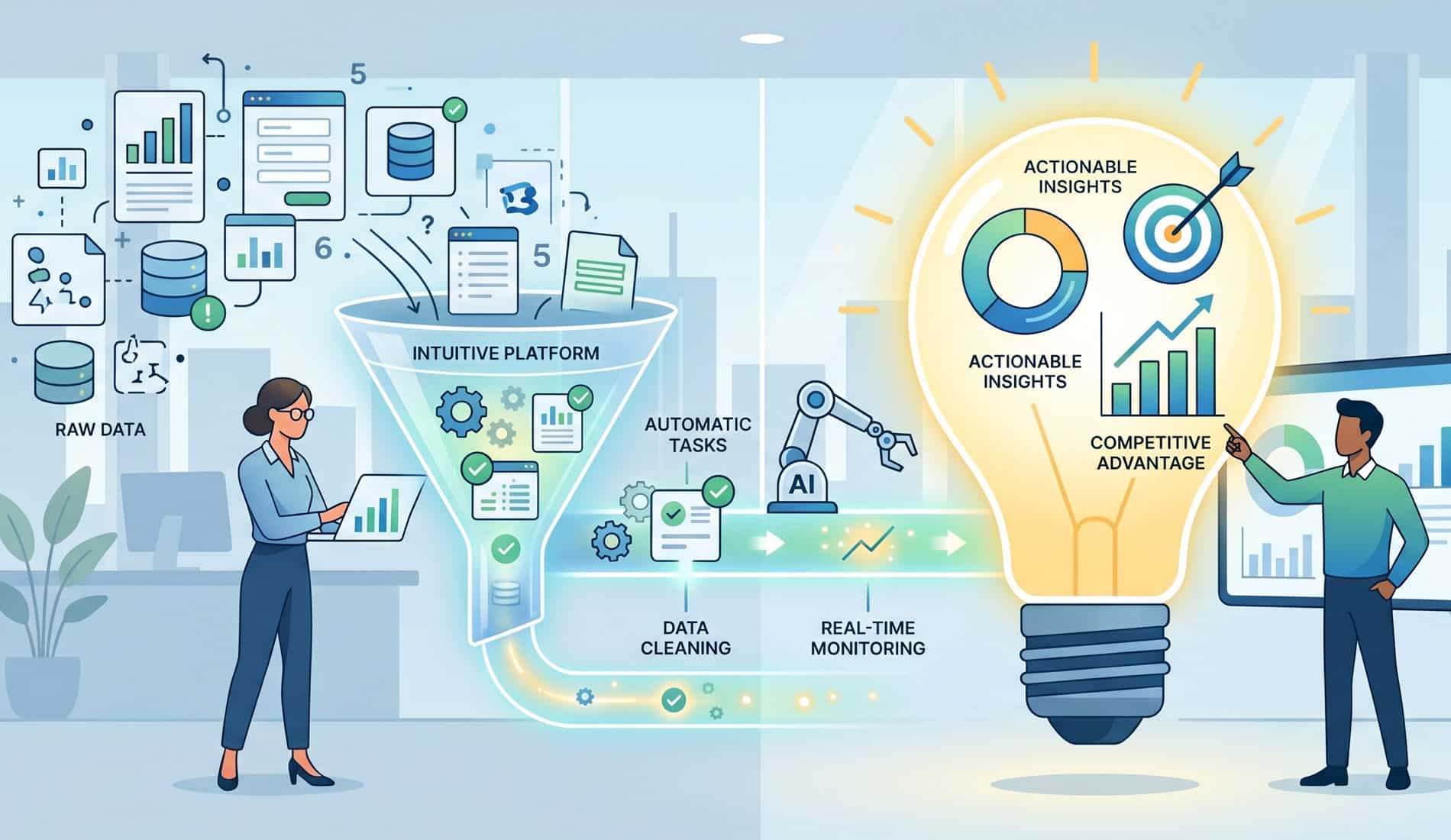
Knowing how to run market research today involves more than just picking the right questions—it’s about building a streamlined, high-speed, and foolproof process. Many projects don’t fail because of the methodology; they fail because of operational friction, such as over-complicated tools and manual workflows.
When data takes too long to process, it loses its value. That’s why cutting down time-to-insight (TTI)—the speed at which raw data becomes usable knowledge—has become a top priority.
The stages of market research: identifying the bottlenecks
On paper, market research is a straightforward flow: design the survey, launch it, collect responses, and analyze the data.
But in reality, each stage is prone to critical issues. Complex survey logic can lead to broken paths and respondent errors; data collection is often plagued by poor-quality or inconsistent results; and analysis—instead of being seamless—becomes a manual chore of exporting and scrubbing data. The real challenge isn’t figuring out how to do research, but how to streamline it to cut down the time it takes to get to the “aha!” moment with reliable insights.
Streamlining your market research process
To take your research to the next level, focus on these four pillars:
1. Streamline the survey
Keep it lean:
- skip complex logic
- double-check the user flow
- ditch the “nice-to-have” questions that don’t add value.
2. Real-time data monitoring
Keep an eye on:
- response rates
- bounce rates
- time-to-completeProactively fix bugs on the fly. Your survey tool should be flexible enough to allow live edits so you don’t compromise your data set.
3. Automate data scrubbing
- Flag:
- “speeders”
- contradictory answers that hurt data quality
4. Faster path to insights
Forget the endless “Export to Excel” cycle. Use instant dashboards to analyze data as it comes in.
The tech stack advantage: why your tools are a game-changer
When it comes to mastering market research, people often overlook the power of the tools they’re using. A clunky or outdated survey platform can:
- Drive up errors
- Kill your momentum
- Require specialized technical skills
On the flip side, an intuitive platform lets you:
- Build surveys in record time
- Slash operational friction
- Hit your “aha!” moment much faster
Ultimately, operational simplicity isn’t just a “nice-to-have”—it’s a competitive edge that levels up both the research process and the final results.
AI in research: a game-changer (when used right)
Artificial Intelligence is already making a massive impact on market research, specifically by streamlining the most tedious, repetitive tasks. For instance, it can supercharge the analysis of open-ended responses—automatically spotting recurring themes and categorizing massive amounts of text in seconds. It’s also a powerhouse for data cleaning, flagging outliers or suspicious behavior (like “speeders” or inconsistent patterns) to boost your overall dataset quality. In some cases, AI can even assist in the design phase, suggesting clearer phrasing or smart follow-up questions.
However, the real magic happens when AI is part of a human-in-the-loop approach. This means technology doesn’t replace the researcher; it empowers them. By automating low-value, grunt-work tasks, AI frees up humans to stay in control of the most critical decisions. At the end of the day, interpreting data, understanding context, and turning insights into strategic moves are still uniquely human superpowers.
Mastering market research today isn’t about how much data you can hoard—it’s about how efficiently you can manage the entire workflow. Cutting down operational lag, minimizing errors during design and collection, and creating a seamless flow between tasks are no longer secondary goals; they are the core pillars of research quality.
In this landscape, the real divide isn’t between those with the most data and those with the least. It’s between those who can turn data into quick, actionable decisions and those who get bogged down in operational complexity.
That’s why your tech stack isn’t just a technical detail—it’s a strategic choice that directly impacts the speed and reliability of your business moves. More and more, the winner isn’t decided by what is analyzed, but by how fast you can get to a result that actually moves the needle.