
AI Adaptive Follow-Up Questions
Collect richer responses with AI-generated follow-up questions
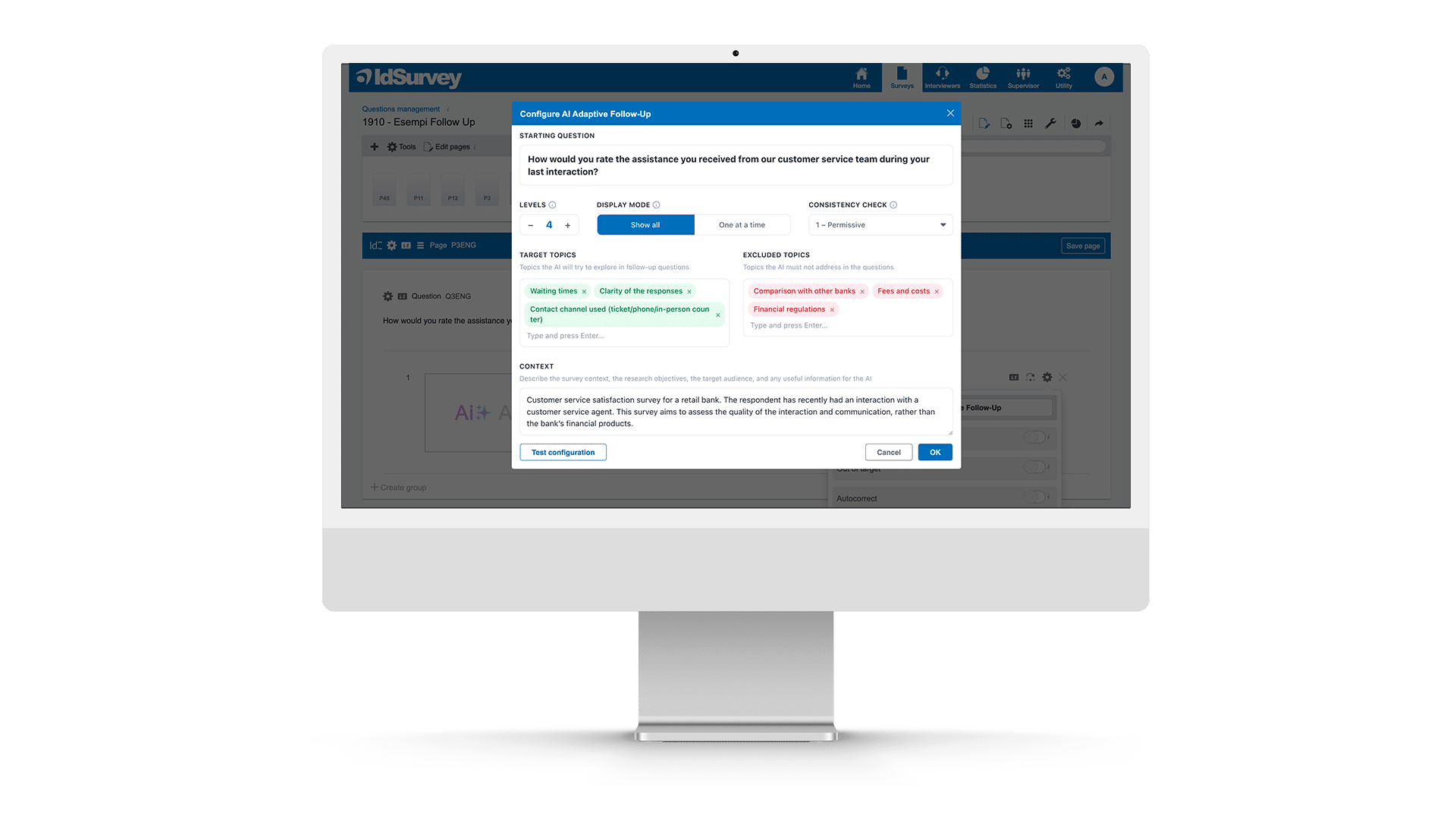
Artificial Intelligence at the service of data quality
IdSurvey’s AI Adaptive Follow-Up Questions transform traditional open-ended questions into guided, contextualized conversations. Specify the topics to delve into and the number of follow-ups: IdSurvey automatically generates relevant follow-up questions, validates the quality of responses, and allows you to gather richer and more reliable insights. All within a single integrated environment.
Native integration without external tools
Integrate the best of the qualitative world into quantitative research. With IdSurvey, you can add adaptive follow-up questions without using external tools or complex integrations. Everything happens within a single, simple, and immediate workflow.
Absolute control over context and themes
Set objectives, relevant themes, and topics to exclude, keeping full control over the focus of the conversation at all times. Artificial intelligence uses your guidelines to generate consistent follow-up questions, avoiding non-pertinent deviations and focusing on the aspects you wish to explore.
Intelligent response consistency check
During compilation, every response is checked automatically: if it is too short, unclear, or not pertinent, the system asks the respondent to expand or correct it. This reduces data "noise" and helps you gather truly useful information for your decisions.
Exporting Follow-Up questions
Export collected responses in Excel or CSV formats. Choose between a faithful summary of each conversation or a turn-by-turn detail, ready to be used with third-party qualitative analysis tools.
Flexibility of structure and follow-up levels
Decide how many follow-up levels to activate by configuring the depth of the dialogue. Choose how to display the questions: one at a time, to maintain focus, or all in sequence, to provide an overview of the journey.
Multilingual survey support
In multilingual surveys, IdSurvey generates follow-up questions in the languages you defined, always maintaining consistency without manual interventions on code or prompts.
Testimonials








Discover IdSurvey's AI Adaptive Follow-Up Questions
Change the way you listen to your respondents. See them in action with a customized demo.
AI Adaptive Follow-Up Questions vs. Simple open-ended questions
| Feature - Dimension | Simple open-ended question | AI Adaptive Follow-Up Questions |
|---|---|---|
| Collected data depth | Simple open-ended question Limited to a few words or broken phrases. | AI Adaptive Follow-Up In-depth, rich in details and nuances. |
| Respondent engagement | Simple open-ended question The user receives no prompts after the initial entry. | AI Adaptive Follow-Up Active and personalized probing based on the response provided. |
| Response consistency | Simple open-ended question Some users may write responses that are too short, random, or off-topic. | AI Adaptive Follow-Up Real-time consistency check on 4 scalable levels, from permissive to strict. |
| Thematic guidance (targeting) | Simple open-ended question Impossible to direct the user's focus within free text. | AI Adaptive Follow-Up Targeted exploration thanks to target topic settings. |
| Context protection | Simple open-ended question The text is not bound to specific objectives. | AI Adaptive Follow-Up Adherence to the research context and excluded topics. |
| Final output structure | Simple open-ended question Fragmented raw data, often difficult to categorize. | AI Adaptive Follow-Up A faithful summary of each conversation or turn-by-turn detail. |
Questions and Answers about AI Adaptive Follow-Up Questions
What are the immediate economic and management advantages compared to using external tools?
Native integration eliminates additional costs associated with third-party platforms and removes the need to configure complex prompts on separate interfaces.
How does this technology affect the respondent's user experience?
It prevents interruptions, artificial steps, or graphical slowdowns during the transition between survey questions and follow-ups, ensuring a consistent interface and a smooth navigation flow.
What are the benefits of software fluidity on survey results?
It optimizes setup times and reduces drop-out rates, even in the most complex qualitative surveys, promoting more complete data collection and a higher response rate.
How do you prevent the artificial intelligence from going off-topic during follow-ups?
By entering a description of the context (objectives, targets, and background information) that the AI will use to adapt the tone and focus of its questions.
What are target topics and what is their role?
They are keywords or macro-themes that the AI will explore further, prompting the respondent to provide targeted details to collect typical qualitative research data.
Is it possible to set limits on the topics covered to avoid distracting the respondent?
Yes, the platform allows you to specify topics that are excluded or irrelevant to the research. The AI will avoid mentioning them, eliminating distractions and keeping the focus on the aspects actually under investigation.
What is the number of levels in adaptive questions and how is it defined?
It is the setting that determines the exact number of follow-ups after the initial open-ended question. It allows you to customize the depth of the survey, balancing information richness and interview length.
What sequence display options are available and what impact do they have on the user experience?
You can choose single display (one interaction at a time) to keep the interface clean and avoid bias, or full sequence to encourage a continuous narrative flow and self-reflection.
What are the four configurable tolerance levels for consistency checking?
IdSurvey offers the following modes: “disabled” (accepts everything), “permissive” (accepts very short responses), “balanced” (requires relevance and consistency), and “strict” (requires extensively argued and exhaustive texts).
How does the software behave if the respondent enters a response that is too short or elusive?
The system invites the user to modify or enrich the text, automatically generating a clarification request consistent with the conversation.
How can you verify the behavior of the artificial intelligence before official publication?
By using the preview environment to type test responses and observe the AI’s follow-ups in real time; this allows you to fine-tune the context, targets, and consistency levels.
What are the planned export options for qualitative data?
The platform allows exporting qualitative data in two modes: as a faithful summary of the interaction generated by AI follow-ups, or as raw data, with the entire conversation reported step-by-step, including all follow-ups and corresponding respondent answers.
Why is granularity in exporting individual steps useful from a methodological standpoint?
Access to the conversation’s raw data allows you to examine every stage of the interaction, including the generated follow-ups and respective answers. This makes it easier to understand how information emerged and to conduct deeper qualitative analysis.
Are AI Adaptive Follow-Ups ready for multilingual surveys?
In multilingual surveys, follow-up questions are generated in the languages defined by the researcher and maintain consistency without requiring manual interventions on code or prompts.
Does probing quality suffer from cultural differences and geographical contexts of respondents?
No, the AI is trained to understand local cultural nuances and semantic contexts, ensuring relevant and natural follow-ups while keeping the research design uniform.
Discover IdSurvey's AI Adaptive Follow-Up Questions
The best of the qualitative world is now in quantitative research. Try them in action with a customized demo.
Knowledge base
Enter the knowledge base to discover all the solutions and strategies for setting up and designing questionnaires.
Guide and papers
IdSurvey has an online guide for all features of the software so you can easily discover all tools.
Help Desk support
Using your ticket area you can request technical assistance. One of our experts will answer you back shortly.