
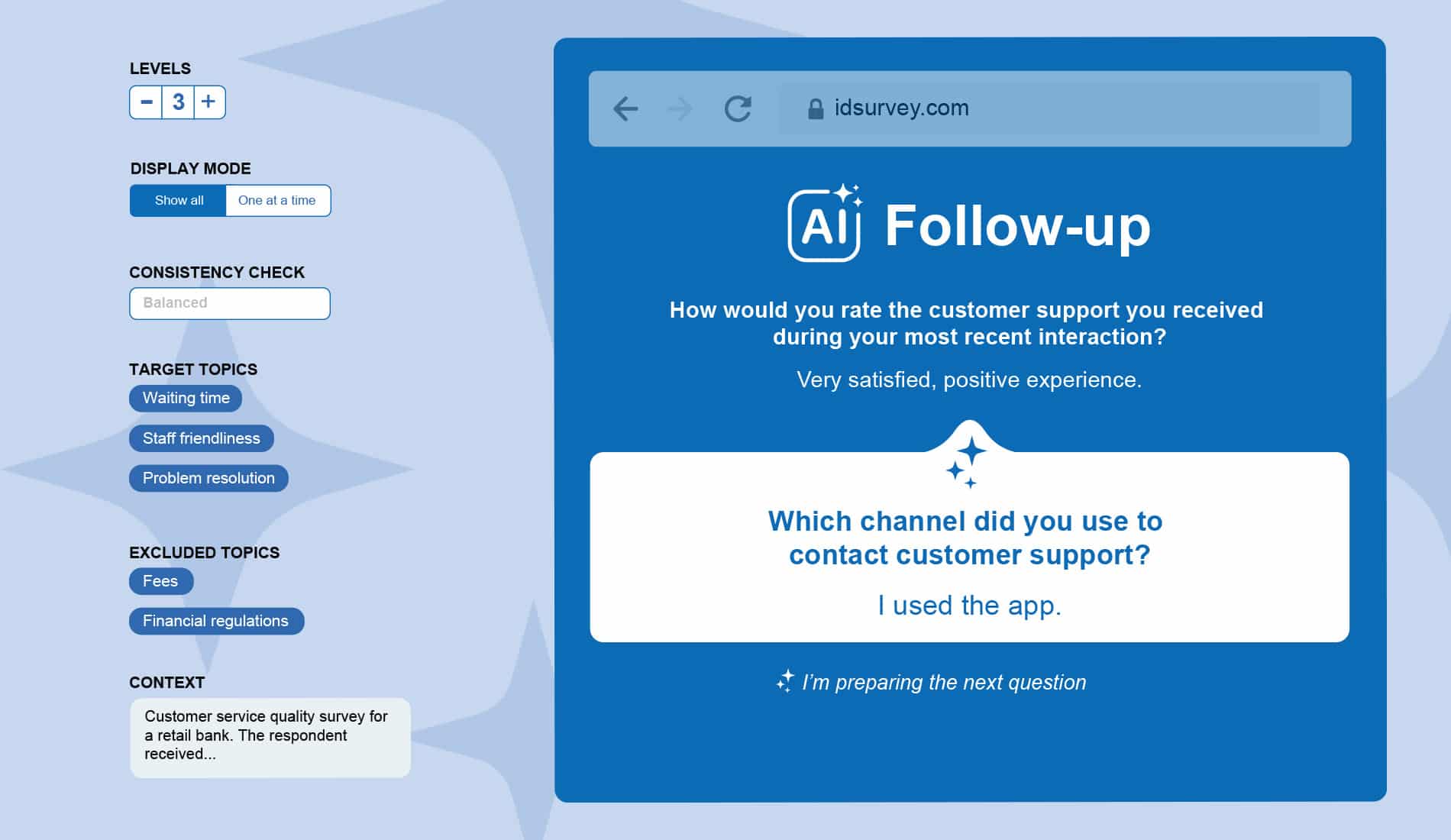
From static questions to AI-powered surveys that listen
For years, surveys have been fstatic research tools. Over time, survey methodology has evolved with increasingly sophisticated features such as advanced skip logic, dynamic quotas, and text piping. Yet the underlying principle has remained the same: every question and every possible survey path is predefined by the researcher before the first respondent even begins the questionnaire.
This approach has made it possible to collect reliable, comparable data at scale, but it comes with a trade-off: limited adaptability. Once a survey is launched, respondents follow the predefined path, and the questionnaire cannot independently explore the most interesting insights that emerge from their answers. If a participant provides a particularly valuable response, the system cannot automatically ask follow-up questions such as “Could you tell me more?” or “What exactly do you mean by that?”.
In qualitative interviews, this happens naturally. An experienced moderator does much more than ask the right questions—they recognize promising insights as they emerge and use follow-up questions to uncover deeper context and meaning.
Today, generative AI makes it possible to bring part of that capability into quantitative research.
This is where AI Adaptive Follow-Up Questions come in—one of the most promising applications of artificial intelligence in online surveys.
The goal of this innovation is not to replace researchers or turn structured questionnaires into open-ended conversations. Instead, it introduces a new level of adaptability by generating contextual follow-up questions based on each respondent’s previous answer. The result is a survey experience that is more relevant, more engaging, and capable of capturing richer, more actionable insights.
Why Follow-Up questions have always been a challenge
Survey researchers know all too well the trade-off between depth and simplicity.
On one hand, the goal is to uncover the motivations behind people’s opinions, attitudes, and behaviors through detailed responses. On the other hand, every additional question increases survey length, respondent fatigue, and the likelihood of survey abandonment.
That’s why open-ended questions are typically limited to a few strategic points in a questionnaire.
The challenge is that open-ended responses vary dramatically. Some participants answer with a single word, others provide detailed explanations, and some introduce entirely unexpected insights that the researcher could not have anticipated during the survey design process.
In a traditional survey, however, all of these responses are treated the same way. If a respondent simply writes “The price,” the survey moves on or ends there. If another respondent writes, “The price has increased too much compared to the perceived quality, especially after the latest product updates,” that answer also receives no further exploration.
In both cases, valuable insights are left unexplored.
In the first example, it would be useful to understand which aspect of the price is causing concern. In the second, the researcher could explore what the respondent means by perceived quality or identify which product changes influenced their opinion.
For decades, this limitation was considered an unavoidable constraint of survey research. Today, however, generative AI is fundamentally changing that assumption, making it possible for surveys to probe deeper into respondents’ answers in real time.
What are AI Adaptive Follow-Up Questions?
The term AI Follow-Up Questions refers to questions dynamically generated by artificial intelligence based on the response just provided by a participant.
In other words, the system does not simply read the text entered by a respondent—it interprets the meaning behind the answer and generates a relevant follow-up question based on the information it has just collected.
The most interesting aspect is that these questions are not written in advance by the researcher. Instead, they are created in real time during the interview by the AI system, based on guidelines and objectives defined by the researcher.
For example, if a participant says:
“I switched banks because customer support had become extremely slow.”
A possible follow-up question could be:
“Can you describe a specific experience that made you feel customer support had declined?”
If another participant writes:
“I chose this product mainly because of its environmental impact.”
The next question could become:
“Which sustainability-related factors had the greatest influence on your decision?”
The interaction remains focused on the research objective, but it gains a level of adaptability that, until recently, was only possible in interviews conducted by a human researcher.
The methodological value of contextual follow-up
The main advantage of AI Follow-Up Questions is not simply the ability to add an extra question. The real value lies in their ability to collect deeper contextual information.
Many consumer decisions are not driven by a single factor.
Behind a short or one-word response, there are often hidden motivations, emotional factors, past experiences, expectations, and comparisons with competitors that are unlikely to emerge from a single open-ended question.
Contextual follow-up allows researchers to uncover these nuances, generating at least three key methodological benefits:
- Data quality: Responses become richer and more descriptive, making them more valuable for subsequent qualitative analysis or AI-assisted coding processes.
- Discovery of unexpected insights: Many important discoveries come from identifying themes that researchers did not anticipate during survey design. AI Follow-Up Questions increase the likelihood that these elements emerge naturally from respondents’ answers.
- Survey design optimization: Instead of creating highly complex survey structures with dozens of conditional paths and alternative questions, researchers can delegate part of the exploration process to artificial intelligence while still maintaining control over the research objectives.
A new form of adaptability
Over the past two decades, survey personalization has evolved primarily through conditional logic and text piping.
Display and skip logic determine which questions are shown or hidden, while text piping personalizes the questionnaire by incorporating information that has already been collected.
AI Follow-Up Questions introduce a different form of adaptability: they do not simply modify the survey flow—they transform the content of the interaction itself.
Traditional survey logic operates based on predefined rules established before data collection begins. Artificial intelligence, on the other hand, interprets the meaning behind a respondent’s answer and generates a contextual follow-up question in real time.
From a methodological perspective, this represents a fundamental shift. A survey is no longer just a fully predetermined sequence of questions; it becomes a dynamic system capable of responding to the information that emerges throughout the interview.
| Traditional approach | AI Follow-Up Question |
|---|---|
| Questions are fully defined during the survey design phase. | Some questions are generated dynamically based on respondents’ answers. |
| All follow-up questions must be anticipated in advance. | Follow-up questions can adapt to the content provided by the respondent. |
| Complex survey paths are required to cover multiple scenarios. | AI can handle part of the probing process while keeping the research objectives defined by the researcher. |
| Open-ended responses may remain superficial or incomplete. | More detailed insights can be obtained by asking contextual follow-up questions. |
Naturally, this adaptability must operate within clearly defined boundaries. The goal is not to create completely open-ended conversations, as would happen in qualitative research, but to maintain alignment with the research design while avoiding irrelevant or overly generic questions.
Methodological challenges
Like any innovation, AI Follow-Up Questions also introduce new methodological challenges.
- Standardization. One of the fundamental principles of quantitative research is ensuring that all participants experience comparable interview conditions. When questions are generated dynamically, researchers must ensure that differences in follow-up interactions do not introduce systematic bias.
- Methodological control. Researchers need to be able to define the level of autonomy given to artificial intelligence by setting parameters such as the number of follow-up questions allowed, the objectives to pursue, and the topics to avoid.
- Language quality. A follow-up question must be clear, neutral, and free from implicit bias or suggestions. Even when generated by a language model, it must follow the same methodological principles that apply to any research question.
- Transparency. An increasing number of organizations consider it important to inform participants when certain survey interactions are generated through artificial intelligence systems. This transparency helps strengthen trust and maintain a positive relationship with respondents.
When AI Follow-Up Questions are truly valuable
Not every research project benefits equally from this technology. AI Follow-Up Questions are particularly effective when the goal is to understand why a behavior occurs rather than simply measure how frequently it happens.
For this reason, customer experience research, brand perception studies, satisfaction analysis, product testing, and exploratory research represent ideal use cases.
In these scenarios, the primary objective is not only to understand the opinion expressed by participants, but also to uncover the motivations behind those opinions.
There are, however, situations where the benefits may be more limited. Highly standardized surveys, longitudinal studies that require strict comparability over time, or questionnaires based almost entirely on closed-ended scales may gain less value from dynamically generated questions.
As with any technology, its effectiveness depends on how well it aligns with the goals of the research.
From theory to practice
AI Follow-Up Questions are gradually becoming part of professional online research platforms, showing that this capability is no longer just a theoretical concept but a practical option for survey designers.
IdSurvey has also recently introduced this functionality, enabling researchers to automatically generate contextual follow-up questions based on participants’ open-ended responses. The goal is not to replace the researcher’s methodological expertise, but to enhance it with a tool that can capture deeper insights without making questionnaires unnecessarily complex through dozens of predefined paths.
This evolution represents an example of how artificial intelligence can be applied to research while preserving its fundamental principles. When used thoughtfully, AI Follow-Up Questions help bring the richness of qualitative interviews closer to the scalability of surveys, creating new opportunities to better understand respondents’ motivations, behaviors, and experiences.
The challenge in the coming years will not be deciding whether artificial intelligence should be used in research. Instead, it will be determining how to apply it in a methodologically sound way—keeping data quality and professional research judgment at the center of the process.
AI Follow-Up Questions represent one of the first concrete examples of this transformation: not a replacement for human expertise, but a new tool for asking better questions at the right moment.
FAQ about AI Follow-Up Questions
What are AI Follow-Up Questions or adaptive questions?
AI Adaptive Follow-Up Questions are follow-up questions generated by artificial intelligence based on the answers provided by participants to an open-ended text question. Unlike predefined questions, they are created dynamically to further explore a topic that emerges during the interview.
What types of research benefit most from AI Follow-Up Questions?
They are particularly valuable in research where understanding motivations, opinions, and experiences is essential, such as customer experience research, satisfaction studies, market research, brand analysis, and product testing.
Can AI-generated questions compromise data quality?
Like any research tool, AI Follow-Up Questions should be used within a controlled methodological framework. Data quality depends on how the system is configured, the objectives of the study, and the researcher’s ability to define clear guidelines for its use.
What is the difference between a traditional open-ended question and an AI Follow-Up Question?
An open-ended question collects spontaneous feedback but often provides no opportunity for further exploration. An AI Follow-Up Question analyzes that response and generates a targeted follow-up question in real time, similar to what an experienced interviewer would do.