
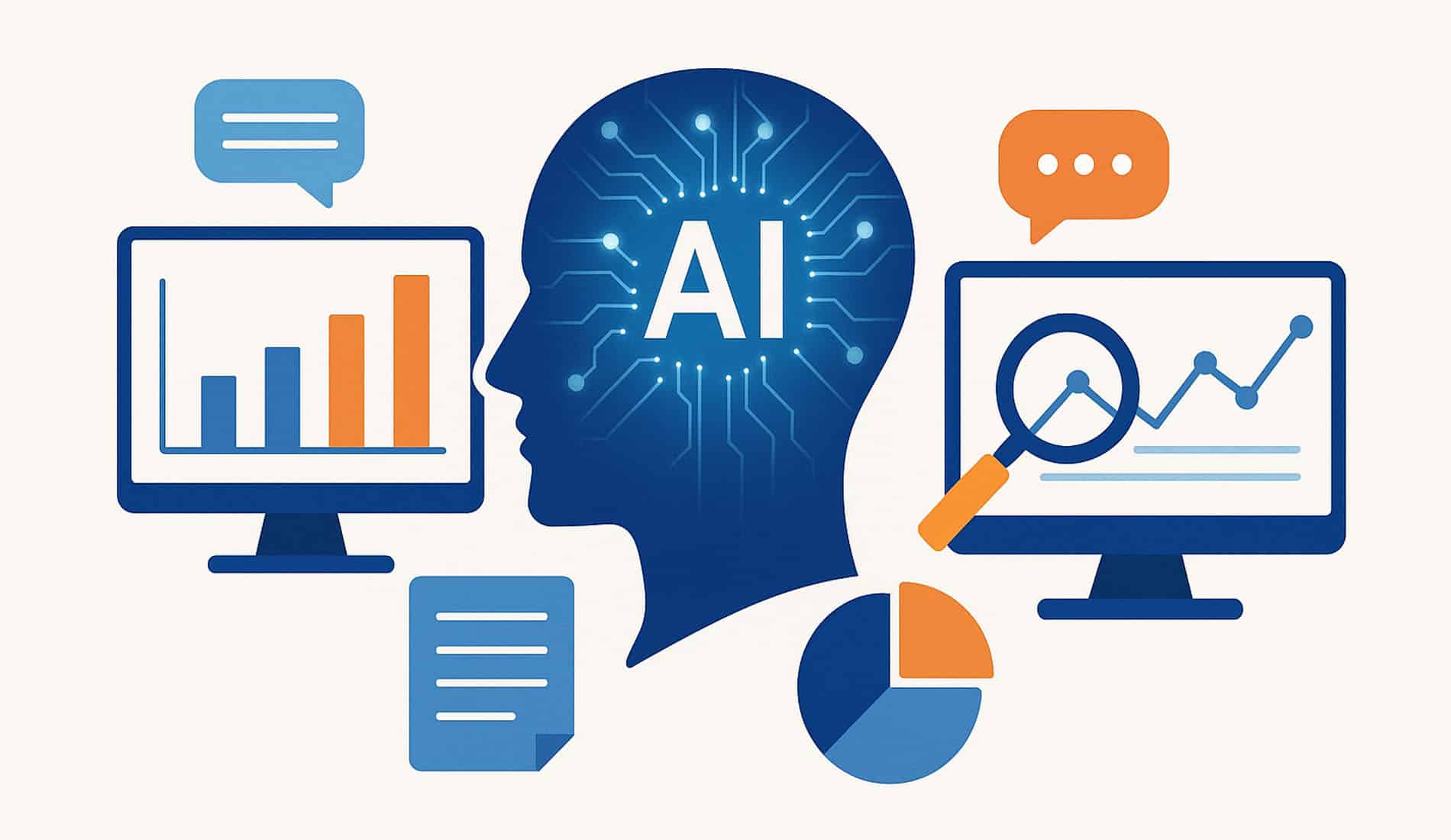
Artificial Intelligence (AI) is redefining the world of market research faster than any other technological innovation.
While the Internet took over 15 years to become mainstream, generative AI has achieved this in less than three. Today, survey tools with AI enable the design, distribution, and analysis of questionnaires in record time, integrating automation, machine learning, and predictive analysis. For quantitative research professionals, this means new opportunities for efficiency, accuracy, and immediate insights.
Key trends
The change is more rapid than many organizations anticipated, and those who integrate it first will gain a competitive advantage.
During the ESOMAR webinar “How to Leverage AI for Market Research and Insights,” Ray Poynter (ResearchWiseAI & NewMR) identified three main trends shaping the future of AI in market research:
- Unprecedented speed of change: The evolution of AI models is exponential. Large Language Models (LLMs) are updated every few months, rapidly making established techniques and workflows obsolete. This pace requires researchers and companies to adapt continuously, updating tools and skills to remain competitive.
- Volatile market and “Winner takes all”: The first to effectively leverage AI in the research sector will gain a strategic advantage. Companies like Meta, Google, and OpenAI are investing billions to achieve “superintelligence,” but in the context of market research, this primarily means integrating AI into insight generation processes—not just as an accessory technology but as a central part of the decision-making flow.
- Transformation of skills: Researchers are no longer just analysts or data scientists but “AI supervisors”: figures capable of guiding generative models, setting effective prompts, validating results, and interpreting them within the context of research data. Soft skills—critical thinking, creativity, empathy—remain crucial for making sense of machine outputs.
In summary: AI will not replace research, but it will radically change how research is conceived, designed, and analyzed.
AI in quantitative research
The impact of AI in quantitative research is profound and concrete.
Traditionally, quantitative research relies on structured data from surveys or panels; today, AI allows for the expansion, interpretation, and validation of this data in ways previously impossible.
- Automated and predictive analysis: AI can identify hidden correlations in datasets, generate behavior clusters, and predict future trends. Machine learning models are already used for dynamic segmentation and driver analysis, reducing the time and cost of traditional statistical analyses.
- Data cleaning and validation: survey tools with integrated AI can detect inconsistent responses, suspicious patterns, or “straight lining” (overly uniform responses) in real-time. This improves the quality of collected data, reducing the need for manual post-field checks.
- Automated reporting: AI automatically transforms datasets into interactive dashboards and reports written in natural language (“Natural Language Generation”), making results immediately readable even for non-analysts and significantly speeding up professional work.
- Fusion of quantitative and qualitative data: AI allows for combining numbers and text: open-ended responses are analyzed semantically and linked to quantitative variables, offering a richer view of respondent behavior and motivations.
- New data collection models: The emergence of conversational surveys—questionnaires conducted via chat, voice assistants, or digital avatars—represents the most promising frontier. These tools make the experience more natural for the respondent and improve completion rates.
- Synthetic data and synthetic personas: One of the most interesting evolutions of AI-driven quantitative research concerns the generation and use of synthetic data: information artificially created by AI to replicate the statistical characteristics of real data.
These datasets can be used to:
- Supplement existing samples (increasing the statistical base of hard-to-reach subgroups).
- Simulate market scenarios.
- Test questionnaires and analytical models before actual data collection.
Alongside synthetic data, synthetic personas or digital twins are emerging—actual digital entities that mimic the behaviors, preferences, and responses of groups of real people. While not replacing real research, synthetic data and personas represent a valuable integration to expand the analytical depth and predictive capacity of quantitative research, especially in concept testing and trend modeling phases.
Challenges and ethical considerations
The integration of AI into market research processes brings great opportunities but also equally significant responsibilities.
AI is only as powerful as the data it is trained on, and for this very reason, it inevitably reflects the limitations and biases present in its sources. Much of the current models rely on data from Western contexts—what scholars call “WEIRD,” an acronym for Western, Educated, Industrialized, Rich and Democratic—which can introduce cultural and demographic biases that risk distorting result interpretation. It is therefore crucial that researchers maintain a critical view, verifying the representativeness of the data and the neutrality of AI-generated analyses.
The ethical issue is not just about data quality but also security. Survey and analysis platforms must ensure full protection of sensitive information, especially when stored or processed on cloud services. Knowing where data is stored, who can access it, and whether it is used to train external models is now an essential requirement. In response to these needs, “on-premise” solutions and systems based on local models—the so-called edge AI—are emerging, allowing data to be processed directly in controlled environments without the need to send it to remote servers.
Another challenge concerns the reliability of outputs. Generative models, no matter how sophisticated, can produce seemingly coherent but factually incorrect results—the so-called hallucinations. This is why human control remains essential: the human in the loop principle ensures that every insight elaborated by AI is verified, interpreted, and contextualized by an expert before dissemination.
Finally, adopting AI in market research also means taking on a cultural responsibility. Every application should be evaluated not only based on efficiency or precision but also on algorithmic transparency, informed consent of participants, and the environmental impact of data processing. Integrating AI into research is not just a technological choice: it is a decision that redefines how we produce and interpret knowledge.
What to expect in the next 3-5 years
We may not have a crystal ball, but current trends point toward a few clear directions for AI in market research.
- Conversational surveys—through chat, voice, and virtual assistants—are likely to become a standard data collection method.
- AI will soon be integrated end-to-end, from questionnaire design to data collection, analysis, and reporting.
- The role of the researcher will evolve further: from data executor to strategic interpreter and AI supervisor.
- At the same time, continuous training and ethical awareness will be essential for teams managing intelligent survey platforms and interpreting AI-generated models.
The ESOMAR webinar highlighted what many in the industry are already sensing: AI is no longer a future trend—it’s a present reality transforming every layer of market research. From survey design to data analysis, automation and generative models are redefining what’s possible, while also challenging us to rethink our role as researchers.
Artificial intelligence doesn’t replace human expertise—it enhances it. The future of insight generation lies in the collaboration between humans and intelligent systems: humans providing context, empathy, and interpretation; AI delivering speed, scale, and analytical depth.
For those using AI survey tools, CAWI/CATI platforms, or quantitative research software, now is the time to experiment, learn, and lead. The organizations that embrace responsible AI today will set the standards for tomorrow’s research industry.
At IdSurvey, we believe that the true power of AI in market research lies in its ability to amplify human intelligence—not to replace it, but to help it reach further, faster, and with greater precision.